Lifesaver
by Frank Bures
Rotary Canada -- April 2013
On a cool Monday morning in 2011, Scott Dudley got in his car and started driving north.
He was not supposed to be on his way to Canada. He was supposed to be in Haiti helping with the earthquake recovery effort. That trip had been cancelled at the last minute due to political turmoil, so Dudley, a member of the Rotary Club of North Whidbey Island Sunrise in Oak Harbor, Wash., USA, had some unexpected time off. He felt he should do something useful.
He looked at a map. Then he looked at the Rotary clubs in his district, situated on both sides of the U.S.-Canadian border. He figured if he planned well enough, he could visit 13 of the District 5050 clubs that week.
“I just told my wife: I need to go do this,” he recalls. “I feel compelled to do this.”
The meetings went well enough. On Monday, he visited three clubs. On Tuesday, he went to three more. On Wednesday, he went to two, then headed to the Meadow Gardens Golf Club, where the Rotary Club of Haney, B.C., was holding its usual weekly meeting that evening.
The scheduled speaker didn’t show up, so Dudley agreed to give a talk about membership. Keesha Rosario, a young member of the Haney club, was sitting in the back of the room. At one point during the meeting, someone at her table asked, “How are Phil’s kidneys doing?” Another person told her she should share what was going on during happy dollars.
She got up, donated $5, and explained how her 37-year-old husband, Phil, had noticed a gurgling in his lungs during a business trip. Keesha took him to the doctor at home, who immediately admitted him to the hospital. Phil’s heart rate was through the roof, and he spent several days in intensive care while doctors figured out what was wrong with him. After an ultrasound, they told him that his kidneys were covered in cysts and were functioning at only 20 per cent capacity. Was he aware, they asked, that he had a genetic condition called polycystic kidney disease? He wasn’t. “It was a total blindside,” Phil says.
Keesha finished telling the story and sat down. Dudley leaned back in his chair. He knew the illness well. His grandmother had died from it. His aunt had succumbed to it too, even after she’d received a kidney from her sister. His uncle had to have a transplant from a deceased donor. Dudley knew the toll it would take on the young couple.
He also knew he could do something about it. Dudley had been tested and didn’t have the gene for the disease. Because of his family’s experience, he had considered becoming a live donor for years. After the meeting, he told Keesha, “I think I’ve got your husband’s kidney. How can we make this happen?”
Keesha was taken aback. “Make what happen?”
“How can I get tested,” he went on, “to be a donor for your husband?”
Cautiously, Keesha reached into her purse and handed him a card she’d received at the hospital. There was an 8- to 10-year waiting list for donated kidneys, and the Rosarios had been preparing themselves for the long wait.
“She came home and said, ‘I think I got you a match,’” Phil recalls. “I didn’t want to believe it. It was too random. I mean, you go to the Rotary club and someone offers you a kidney?”
Life in waiting
Keesha and Phil went back to their harsh reality: rest, diet change, and working with a team of doctors to strengthen Phil’s heart. “I took it like a bad hand at poker,” he says. “The cards had been dealt, and I figured it was my path in life, and I was just going to have to face it.”
Often, the couple’s thoughts drifted across the border, to this stranger who had raised their hopes. The doctors warned them that things might not go according to plan. Dudley might not be a match. He might have second thoughts. He might not pass any number of tests Ц or he might just bow out. “In general, it was hard to believe,” Phil says.
Phil wasn’t the only one who was wary.
“When I was being interviewed at Vancouver General Hospital, they asked how well I knew the recipient,” Dudley says. “I said, ‘I don’t know him at all. I have a name.’ Bells and whistles go off, and they think you’re getting paid under the table,” he adds. More questions arose, and it became clear that Dudley’s commitment to service was a driving force behind the donation.
Years earlier, Dudley had been in the U.S. Marines, and then in the Navy, training to be a Seal. But when his boat flipped during an exercise, he broke his back, spent time in the hospital, and was sent on his way. His penchant for service, however, was not broken, but channelled into his civilian life as an enthusiastic Rotarian. Today his license plate reads “4 Rotary.” His office walls are covered in Rotary items, and he has huge tattoo of the Rotary emblem over his heart.
For Dudley, Service Above Self is more than a motto.
A match
The months went on, and were busy for everyone. Dudley, a financial planner, ran for mayor of Oak Harbor and won. Phil waited for the results of Dudley’s tests. Nearly a year had passed when Dudley got word that he and Phil were a perfect match of both blood and tissue. The surgeon told him that only an identical twin would have been a better match.
“From day one, I knew I had this guy’s kidney,” Dudley says.
The transplant was tentatively scheduled for the summer of 2012, but in April, Phil contracted a flu that sent his kidney function into the danger zone, and his doctors told him he’d have to start dialysis. Phil asked if the transplant could take place sooner.
The Rosarios didn’t know what was happening on Dudley’s end. They had no idea he would cancel a Rotary service trip to Honduras to make an earlier surgery date work.
That April, Keesha was sitting in a seminar at the district assembly when Dudley walked in. It was the first time they’d seen each other in person since their first meeting. As they chatted, Keesha started to cry.
Later, in the hallway, she asked him the foremost question on her mind: “So is this really a go?”
“It’s really a go – May 14,” he said.
The surgery
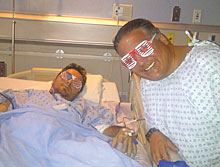
The month went by quickly. The surgery went smoothly. A couple of days afterward, Dudley was in Phil’s room, ribbing him about having a U.S. Marine kidney working away in him.
Eventually the local journalists who had been following the story went home. So did Dudley and the Rosarios. Both men recovered. To date, Phil has had minor complications, and Dudley hasn’t had any. The news reports made much of the fact that an American would give a kidney to a Canadian. Inevitably, some people, including Phil, took to calling Dudley a hero. He received a deluge of email from people telling him how inspired they were, or that he had restored their faith in humanity.
Dudley bristles at the idea that he did something heroic. For him, donating was a simple matter, “instead of waiting until I pass away and having them look at my driver’s license to realize that I can help somebody when I’m gone. It’s nice to be able to see the people we help while we’re still here.”
Read a blog post about the kidney donation on Rotary Voices.